Where the friction went
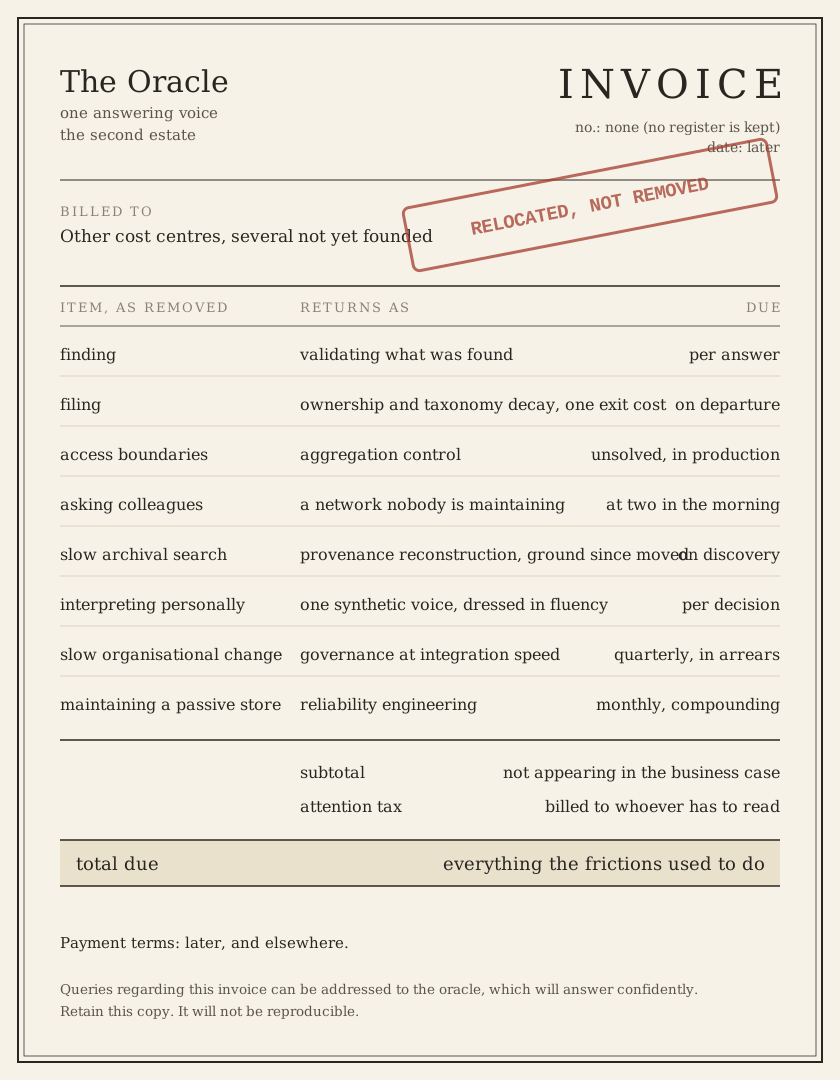
The consultant left by way of the communal dining room, where it was lunch and therefore chaos, and where a minotaur was doing the crossword. Laid end to end, the fortnight’s costs stop looking like a catalogue and start looking like one mechanism observed in different rooms. The friction of finding, in Dr. Flannel’s ward, became the friction of validating what was found. The friction of filing, in the applications office, became the decay of ownership and taxonomy, waiting downstream as an exit cost. The friction of access boundaries, on the cork board, became the problem of aggregation control, which no existing matrix can express and which the Home has more reason than most to want expressed. The friction of asking colleagues, on the walk between the shifts, became the thinning of the network that asking used to maintain. The friction of slow archival search, in the communications office, became the forensic reconstruction of provenance for answers whose ground has since moved. The friction of interpreting documents separately, in Madame Zara’s chairs, became interpretation risk, concentrated in one synthetic voice and dressed in fluency. The friction of slow organisational change, in the DPO’s office, became governance run at integration speed, continually behind. And the friction of maintaining a passive store became reliability engineering for an active component the stack now depends on, and which phase two proposed to hand a bucket of paraffin.
Each entry has the same shape. The oracle gains a capability; an archival restraint lapses; the restraint turns out to have been a control. The old frictions shared three properties that made them cheap: they were visible, they were paid at the moment of the work, and they were paid by the person doing the work, who could feel when the price was wrong. The new frictions invert all three: quiet, deferred, and paid by other people, often by roles that do not yet exist. The relocation is not a defect of an immature product category, and better readers will not repatriate the costs; a more capable oracle relocates more friction, further downstream, more smoothly. What was bought as the removal of friction was, throughout, a change of address.
The licence prices the reading. The remaining bills price everything the frictions used to do, and they arrive, as such bills do, later and elsewhere.
Ponder’s minutes ran to a page and a half. They record that a report was received, that three restorations were discussed and two adopted, that a discussion of reach took place, and, under any other business, that the bucket went down on its rope at six, as it always had, and came up empty.