The answer economy
Asking a question at the Home used to cost something. It meant finding Priya, or the DPO, or the one vampire on the night shift who remembered 2019; it meant explaining enough context to be understood, defending the question’s relevance, and sometimes admitting ignorance in front of Mrs. Clodpull, whose opinion counts. The price was resented, and it was doing selection: questions that could not justify their cost did not get asked, which meant the questions in circulation had passed a filter, and the filter was attention-shaped. Answers were expensive to request, so a request carried information about what someone actually needed to know.
Free questions dissolve the filter, and demand behaves the way demand behaves when a price goes to zero. Every passing uncertainty becomes a query. Every disagreement becomes a request for a synthesis. Every meeting produces a document, the document produces questions, the questions produce answers, and the answers get pasted into the next meeting’s document. The Home becomes a very efficient converter of uncertainty into text, and the conversion can run indefinitely without ever passing through a decision, because deciding was never the step the machinery accelerated. Documents produced to avoid deciding are the supply side; the demand side completes the market: unlimited queries meeting unlimited generation, with attention, the actually scarce input, priced at zero throughout and billed to whoever has to read. At the Home that is the DPO, who reads everything, and the Director, who reads the summaries.
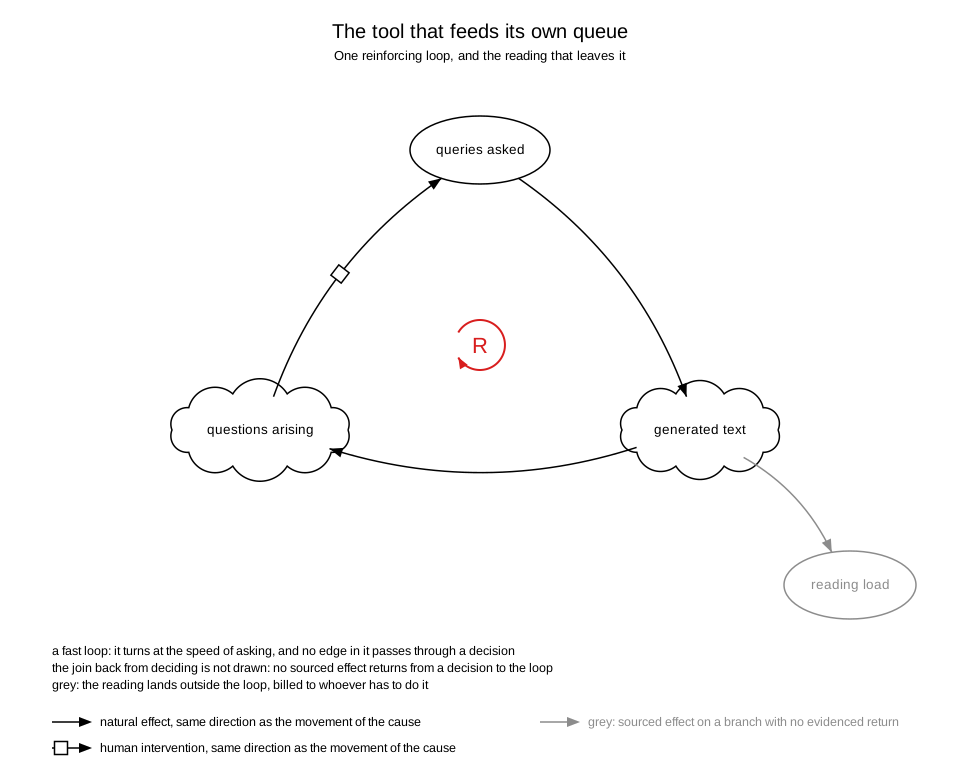
What gets rewarded drifts accordingly. An organisation that measures answer production starts optimising for it, and the production of answers is not the production of understanding, any more than recall was memory. Understanding shows up as fewer questions, better ones, and the occasional refusal to ask before thinking, none of which displays well beside a dashboard of eleven thousand queries served. The danger is that the Home gets progressively better at the step that was never the constraint, and books the improvement as productivity, while the constraint, judgement applied to answers, queues at the same width it always had.
Old friction |
Removed by agent |
New friction |
|---|---|---|
costly questions |
free queries |
attention billed to the reader |