Priced as a reader
The reader had been priced as a reader. A licence per seat, ingestion per gigabyte, an integration project, a governance workshop to reassure the DPO. What it changed, though, was not the reading; it was the nature of the estate. The Home’s estate was a system of frictions as well as a store, and most of the frictions were doing unpaid work: the permissions sprawl that made wholesale reading impractical, the filing effort that forced a classification decision on every document, the obscurity that let dormant records stay dormant, the sheer unreadability of fifteen years of files that functioned as a de facto limit on what any one person, or any one desk, could assemble. Wholesale removal of friction is the product. Each removed friction then sends its bill separately, later, under another name.
The genre changes too. An archive answers the question “what was written”. An oracle answers the question “what is so”. The two have different failure modes, and a reader over a document estate converts the first into the second without anyone signing off on the conversion.
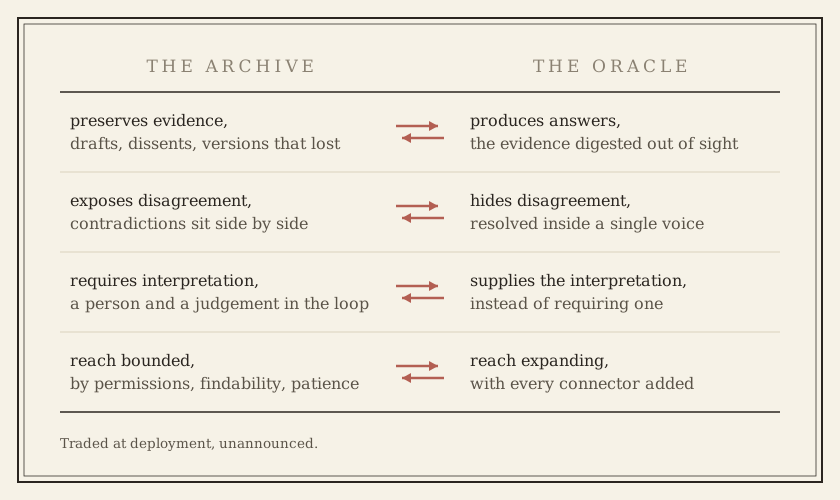
An archive preserves evidence, and evidence includes the awkward kind: the drafts, the dissents, the versions that lost, the intake policy Mrs. Clodpull has never once followed. It exposes disagreement, because contradictory records sit side by side with nothing to reconcile them. It requires interpretation, which keeps a person and a judgement in the loop. And its reach is bounded, by permissions, by findability, by the patience of whoever is looking. An oracle produces answers rather than preserving evidence; hides disagreement inside a single voice; supplies the interpretation instead of requiring one; and its reach expands with every connector added. None of the four exchanges is announced as an exchange. Deployment trades the first set of properties for the second, mostly without anyone noticing that the first set were properties at all, rather than inconveniences.
The deeper change is the relocation of friction. The friction of finding, visible, resented, easy to time, moves downstream of the answer, into deciding, validating, governing, remembering and maintaining, where it is quieter, harder to time, and billed to other cost centres. Friction keeps getting reported as removed because the stopwatch stands at the old location.
Nowhere in the four exchanges does the friction actually go. It returns, and the choice on offer is how: accidentally, as failure, or deliberately, as governance.